HORIZON (Buddhism Blog)
Nam-myoho-renge-kyo
HORIZON NEWSLETTER
a Buddhism blog
January 1, 2023
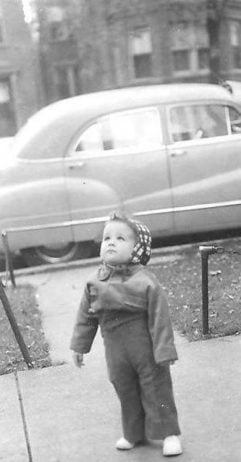
At age 2, my mission begins
Okay, I’m here. Now what?
BLOGITORIAL… by Linda Segall Anable
I have a fundamental need to be creative, like all the time. Unable to be a mere observer of life, I need to create it myself. That’s why I chant. I don’t ask for fortune to come to me; I make my own fortune, through the power of Nam-myoho-renge-kyo. Being a creative type (i.e. full-tilt right-brained) works for me because I am not a logical person (my left-brain doesn’t understand me).I ponder outside the box, suck at tech, am a poor driver, an innovative cook; cannot follow the simplest directions – just do it my way; pull what information I need down from my personal cloud and sometimes from other dimensions. I’m a little weird but in a good way.
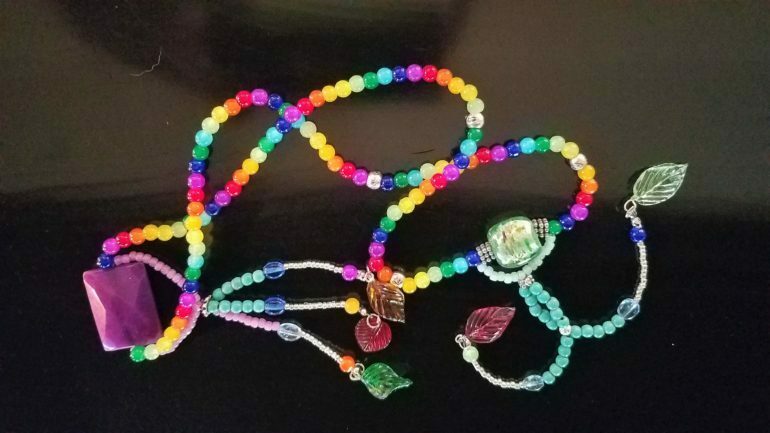
My main occupation is writing; I wrote a novel at age ten (still unfinished), worked in movies and television, and always loved making art. When I started practicing Nichiren Buddhism in 1981, I found I could create amazing benefits just by chanting Nam-myoho-renge-kyo. It can make almost anything happen! Chanting appeals to me on so many levels, not the least of which: it’s the most creative activity ever! I also fell in love with Buddhist practice’s most charming accessory: prayer beads, and learned how to make them (self-taught, of course, since I can’t follow directions).
HORIZON
ARCHIVE
I have 30 years of back issues. I don’t have them all linked to this site yet. If you are interested in any back issues, please contact me at: lanable@earthlink.net Thanks!
OCT : 2022
NOV : 2022
DEC : 2022
JAN : 2021
FEB : 2021
MAR : 2021
APR : 2021
APR : 2021
APR : 2021
When I first started making Juzu, about 20 years ago, I used the wrong stringing materials and all of them broke. Every last one. Amazing how much friction beads endure, even if you’re not rubbing them (and don’t do that). Hands express our life condition and when you’re tormented inside, you might take it out on your beads. Breakage can result – which is a very sad experience.
Having learned which materials work and which do not, I now make Juzu with invisible fishing line instead of beading wire or other types of cord. Unlike wire, fishing line won’t wear and break at the junctures, and it’s more supple than the thinnest beading wire. With fishing line, you could be lost in a rubbing frenzy and your beads still won’t fall apart.
But, again, don’t! Rubbing will cause damage to any beads: wood, glass or gemstones, so I urge everyone to please, please avoid rubbing your beads. However, if you occasionally slip into a fretful state when you’re chanting, have a pair of old wooden beads that you can abuse when stressed – that can take a beating.
As serenity is not my signature life condition, working with beads is about the best thing there is to calm me down that isn’t a drug. Stringing tiny things together and keeping them connected requires singular focus. Handling beads in an anxious or distracted state invites disaster in the form of a bead spill. When beads fall, they lose their minds and go places you’d never think possible. One taste of freedom and they can’t be stopped. Sometimes I’ll find one a month later. Or hear that ominous clicking noise when they’re sucked up in the vacuum cleaner. So disturbing.
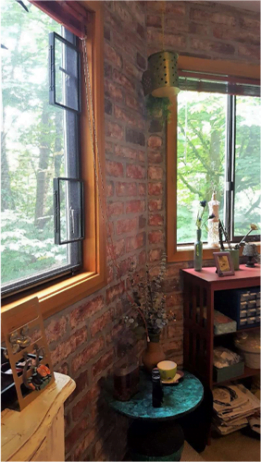
I created my bead parlor (which once was a child’s bedroom with a four-poster bed) to look like an old cavern with brick walls. I painted the outside-facing sides of the woom in trompe l’oeil bricks, and the interior walls as faux concrete. Strung some old chandelier crystals around a plain fixture, and voila – a chandelier. Then I removed the door to the room and replaced it with a bead curtain that took many, many hours of tedious stringing, but it looks great and it’s fun. I was concerned that my dog Jasper would avoid the bead curtain, but he seems to like going in and out of it; the beads making that soft, delightful clattering sound. Jasper always closes his eyes when he pokes through, as he uses his nose to part the beads.
Beads are only an accessory, not essential for attaining enlightenment – but they do have meaning and they take on your energy when you chant with them. While Juzu styles vary, there are a few basic elements: there are 108 beads in the main circle, representing earthly desires, and four smaller beads that represent the enlightened qualities of eternity, tranquility, true self, and purity. Your ten fingers placed together in prayer represent the Ten Worlds. Beads help you focus on the Gohonzon, the scroll that we chant to that represents our enlightened lives and are calming to those of us with nervous hands.
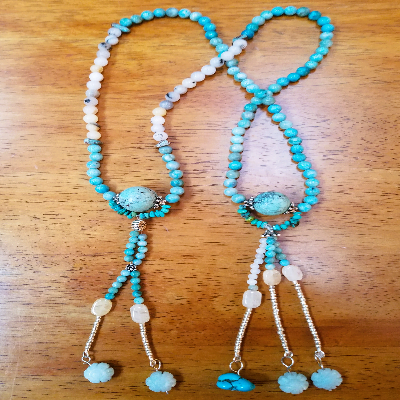
I’m very excited about my new beading adventure. After 30 years of publishing, the Horizon finally has a sponsor: Juzu! My interest in commerce is negligible; I’m in it for the creativity, not the selling. But I’m learning a lot about business by binge-watching Shark Tank and was recently a seller at a holiday market with my dear friend Lindsey, partner in beads and other crafty things. We sold sunglass wranglers (you will never lose your sunglasses again), Xmas mobiles, and holiday earrings. Not only was it a great learning experience, but we also sold a fair amount of merch.
A tremendous amount of work, but worth it. The star of the holiday market turned out to be my dog Jasper, a true Buddha who is spending a physical life down here on crazy planet Earth showing us what enlightenment looks like. Jasper met and gave love to so many people at the holiday market. One woman came by, purchased a couple of sunglass wranglers, then dropped to the floor and had a profound interaction with Jasper: clearly a karmic reunion from the distant past. She even came back the next week to see him again. Many other people exchanged energies with Jasper and were uplifted. Witnessing these encounters was a special experience. Jasper has grown up with the Gohonzon in his life. It shows.
So, from now on the Horizon will be brought to you by… custom made Juzu. If you’re interested in purchasing, here’s how it will go: You list the materials, colors and style – as many details as you can conjure – and I’ll create beads inspired by those criteria. Or, if you have no ideas, I can help with that as well.
Then, I hope you’ll love the beads so much that they’ll inspire you chant more daimoku… which can only hasten the arrival of world peace. That’s a merchandising scheme I can totally get behind. My new website will be up sometime in January. I will send out a notice. If you’d like to discuss beadmaking in the meantime, please email me at lanable@earthlink.net and be sure to put “Juzu” or “Beads” in the subject line.
HEART OF THE ISSUE
by Linda Kaye
Seattle, WA
It is said that the human heart beats about 100,000 times a day. The heart has been the center of many poems, references, metaphors and stories. And there’s the physical heart that must support all the romantic terms and conditions that would not exist without the physical aspect of the heartbeat.
I started chanting when I was a teenager. Of course, sometimes I still think I’m a teenager but, I am still at times coming to terms with aging. About 20 years ago, I put a quote from Ikeda Sensei on my altar which I focused on as a daily thought, or prayer:
“Pray that instead of devils or negative, destructive forces infiltrating your being, Brahma, Shakra and the gods of the Sun and Moon – the positive, protective forces of the universe will enter your life! Pray that they enter the lives of all members in your region and the entire membership of the SGI as well. If you do this, your strength will multiply a hundredfold, a thousandfold. With such a prayer, with such faith, you will realize a fundamental transformation in the very depths of your life. This is the secret to achieving your human revolution” (from a speech by Daisaku Ikeda in July, 2000, published in the World Tribune 9/8/2000, page 1).
Of course, I modified it to add my entire family and friends. That was 2000. It’s 2022. That’s how long I’ve kept this in my daily prayers and on my altar.
My personal goal and aim for 2022 were focused on my health. More like, Oh maybe I’ll do some cosmetics and also take care of some dental work, etc. Well, after months of discomfort from 2021 I found a great doctor who diagnosed me with type 2 diabetes. It’s hereditary. So, there I went onto the prescribed medication and monitoring and dietary lifestyle changes. As I look at my role as an active participant in my healing, I followed all doctor’s orders.
Yet in the summer I started feeling not so well. I thought I had acid reflux. My doctor put me on Nexium. I started having episodes at night. One night it was really uncomfortable. I reached out to her the next morning and told her I thought it was my heart. She immediately had me come in, take an EKG, put me on aspirin and ordered me to the cardiologist. I was a bit taken aback because I had no idea what a heart attack feels like.
I went to the cardiologist, who took an EKG, prescribed nitroglycerin and ordered a stress test. I was seriously freaked out. The nitro was a sign that I might be an old lady (again still coming to terms with aging). Isn’t that just for old people? That was going through my brain. My niece came in from Redding to go with me. My friends were sending daimoku: two examples of “positive and protective forces.” The stress test came and went. The doctor’s prognosis? It was a blur. He couldn’t see everything. Said via an email it could be that I moved. And he noted, “We’ll keep an eye on it and see you in two months.”
I thought I’m good. Heart is fine. Then I lost energy. I was super tired. The episodes continued. I finally tried one tablet of the nitro and the pain went away. Over the next couple of weeks this kept happening. And I thought, well, the cardiologist doesn’t want to see me for two months so it’s probably nothing. Then more than nothing started happening. One day a couple of weeks later, I went to the store. Walking from my car into the store was a true challenge. When I got inside, I went and sat in the deli section and took a nitro pill. The pain went away. I was very worried and concerned and upset. I decided I would call the cardiologist on Monday and ask for an earlier appointment rather than in two months.
On Monday when I called, I spoke to the nurse and told her I was not feeling well at all and what happened over the weekend. I told her this was affecting the quality of my daily life, and my mental health with frustration and anxiety and not knowing what to do. I was frustrated at not getting answers and having to Google symptoms and trying to figure things out myself. The cardiologist called back.
“Could it be that the blur you saw on my stress test be caused by “dense breast tissue?” I asked him. He kind of chuckled. “Yes,” he said without pause. “I didn’t want to offend you.” I immediately schooled him on this. “The women in my family have heart disease and all have dense breast tissue. I’m feeling terrible. Is there anything todo about that?” He replied, “Well, based on how you are feeling I’m ordering an angiogram for this Friday.”
Of course, I Googled that. Then I emailed a few friends to let them know and to please send daimoku and good vibes. More positive and protective forces. I was also actively looking for someone to take me. I asked a neighbor who said yes but declined the next day as they were babysitting a cat. I chanted and decided it was protection of some sort. Another friend could only pick me up afterwards. Then another friend emailed me and said he had the entire day off and he would take me and pick me up. I calmed down right away. Those positive and protective forces were constantly working in my favor! Which brings to mind a statement from President Ikeda:
Above all, the Daishonin did not blithely brandish theories of karma. Making condescending pronouncements to suffering people like “That’s just your karma” will only add to their misery. Someone battling destiny feels like there is a gale raging through his or her heart. When we encounter people in such a state, we should stand with them in the rain, become sopping wet with them and work with them to find a way out of the storm. In the end it is probably all another human being can do” (Learning from the Gosho p. 159).
Not only were my friends standing with me, I also deeply felt President Ikeda’s presence.

The procedure was intense. I was awake the entire time. The surgeon was not my regular cardiologist. He was a cardiologist surgeon. He was nice, talked to me, told me all he was going to do. Quite jovial, smart, funny, and had total command of the room. A positive and protective force appearing in my life! At the end he explained to me what he did and that he inserted a stent. There was a 95%
blockage in my left anterior descending artery also known as the Widow Maker. Had I had a heart attack, it would have been fatal.
After I gained a bit more grounding the next day, it sank into what it was. As intense an experience as this was, I did go back to work on Monday. Fortunately for me, I work at home and love my job. I didn’t miss a beat.
I was furious that it wasn’t caught by the stress test (which was designed by men for men). Heart health has only recently been brought to the forefront as an issue for women. We now know that the number one killer of women is a heart attack or heart disease, beyond breast cancer and car accidents. Why was I furious? Because I wasn’t informed. It wasn’t clear. There was a blur on the X-rays. My dense breast tissue was in the way. There was no other clear way to know, barring the invasive angiogram.
My primary care doctor called me on Sunday night. I discussed it with her how frustrating it was not to have that clear diagnosis by the regular cardiologist I first went to. I went to see my regular cardiologist a couple of weeks later and discussed this with him. I asked him, “I couldn’t be the only women this happens to.” He told me I wasn’t and that it was common. It’s common!! So, I asked, what else can help all women who have this dense breast tissue problem. He said he didn’t know. Maybe an MRI but that was noisy. That’s fine, I told him! Bring the noise!! I don’t have a problem with that! But I had the angiogram and stent and decided how important it is to discuss and bring this up to all women!! This is a big deal!
I wrote a very detailed account of my experience on a survey the hospital sent to me. I signed my name. I don’t need to or want to be anonymous about this. My own primary doctor saw it and I had just gone in to see her two days after the surgery follow up with the cardiologist. She said to me it’s so important to speak up and all the doctors need to hear it. She also offered that once I am through the post-surgery time (3 to 6 months), I can be assigned to another cardiologist. Can’t wait.
One thing I must bring to the forefront is that diabetes and heart health go hand in hand and it’s super important to pay attention to better health choices. For me it presents a double-edged sword. On one hand I have to watch my carbs as my body has a difficult time processing breads, rice, and potatoes to name a few. On the other hand, I have to watch fats as those contribute to build up in the arteries also known as plaque in the arteries. The result is angina, a symptom of coronary artery disease. Angina feels like squeezing, pressure, heaviness, tightness, or pain in the chest. It can be sudden or recur over time. Depending on the severity, it can be treated by lifestyle changes, medication, angioplasty, or surgery.
Sidebar: The holidays don’t make things easy. I bought a little apple pastry thinking, “it shouldn’t hurt.” And then my monitor went off and my blood sugar shot straight up to the heavens. I wear a monitor and it’s super important to keep my numbers low. If they get too high, I must go to the hospital. So, I was walking up and down the hallways of my building and drinking water. Little did I know today’s “positive and protective force of the universe” appeared in the form of the building maintenance manager who saw me and noticed I was in a stressing space. He started to walk with me. Back and forth in the hallway. Finally, my numbers descended a bit. So, we stopped, and I explained what happened. He said, “It’s about the unity of our bodies and what the environment is giving us to eat and drink. Our bodies don’t like the sweet and over dense foodstuff.” When I got inside my apartment, I started chanting for my body to have harmony and unity, and the food I eat to be compatible with my body’s needs.
Now I want to start a revolution. I plan to find a way to put this issue at the top of everyone’s list, especially women. Go get your heart checked! Don’t put it off! It might NOT be heartburn or acid reflux! As women, we do everything for everyone and yet ignore ourselves. Self-care? Yes, do that. Taking care of your heart IS selfcare. Don’t ignore things. This is also true for men. Men also pass by any symptoms by thinking it will pass, or I’m so busy or I don’t really need to call 911. Go to the doctor and ask lots of questions. And for women, if you have dense breast tissue, ask for an MRI. Insist on it!
My new mission for kosen-rufu is to passionately promote women’s heart health. Heart health and research have been based on men’s bodies, not women’s bodies, and it’s only in the last 10 years women’s heart health has come to the forefront. I’m determined to give my all to this cause, because I very easily could have not been here to tell you about it.
“I didn’t believe in myself. Like all people, you second guess your ability, your place and where you can be best valued.” – Chanpone Sinlapasai, the first ethnic Lao judge in the USA
CONFRONTING SELF-DOUBT
by Lynette Yetter
Portland, OR
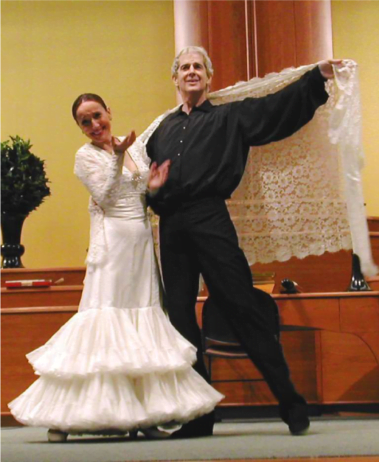
Self-doubt. I had internalized society’s disregard for creativity, for art, for artists. In the late 1990s I attended as many Arts Conferences as I could at the FNCC. They sold out quickly every year. Flamenco dancer Pascual Olivera facilitated the conferences. He once gave a talk about the “self-doubt” that he had experienced that almost led to suicide, but he decided to do gongyo first and the suicidal urge passed. That was his first benefit from embracing Buddhism. Pascual was passionate about encouraging all us artists to use our Buddhist practice to overcome self-doubt. I was so riddled by self-doubt that I thought I didn’t have any doubt. I couldn’t see the forest for the trees. Now I see how pervasive self-doubt was and is. It seems that self-doubt happens to everyone, except maybe narcissists. My creative journey has often taken me slogging through swamps of self-doubt.
But creativity is an aspect of being human. I once read that the Balinese indigenous language has no word for “art.” I mean, their culture is brimming over with art: colorful masks, intricate designs, amazing gamelan orchestras. But no word for “art.” Maybe it’s because everyone’s creative impulses have free play. Instead of calling it “art,” it’s making or doing things, anything, with care and love.
The Suya of the Peruvian Amazon spend hours every afternoon teaching their ritual songs to their children, because they sing their culture, their society, into existence. Everyone is a singer, an artist, a creator of society.
This reminds me of another talk at the FNCC by Pascual. He had the opportunity to speak personally with Sensei on more than one occasion. He shared that Sensei told him that kosen-rufu could be realized by the SGI Arts Division alone. Like the Suya singing their society into existence, SGI artists can create kosen-rufu. And Sensei says that each one of us is an artist, an artist of life.
But what about that self-doubt? I have some technicolor memories of moments in this lifetime when self-doubt was planted and nurtured. Things like this I think happen to most all of us. For example, when I was 8 years old, my grade school had an art exhibition of student art. I lovingly made whatever it was I’d entered. I don’t remember what I entered. What I do remember is that the blue ribbon for the best third grade artwork went to a girl who could paint oil paintings that were so good that the judges at first disqualified her work because they thought it was a paint-by-number. Her mom challenged it. So, the judges watched the girl paint an oil painting that looked like a Monet and awarded her first prize. Wow! That child prodigy was an artist. That meant I was not an artist because I couldn’t paint that well. Self-doubt.
At age 14, I was singing songs in the bathroom that I was learning at school in Girls’ Glee. My stepmom, who’d been a professional jazz singer in her youth, shouted through the door, “If you can’t sing in key, don’t sing at all!” At that moment I decided I was tone deaf and didn’t know it. Self-doubt.
But creative urges are part of being human. My creativity yearned for development and expression, even though I believed I was a tone-deaf non-artist. When I took an ear training class in college, I ended up in tears it seemed almost every day. I’d correctly sing “do mi sol mi do” with teacher Fred at the piano, then inside negative thoughts would say, “You can’t do that. You’re tone deaf.” The tension between my creative urge and my internalized self-doubt was excruciating.
When I was a senior in college, I received my Gohonzon and studied and practiced with my whole heart. By chanting I overcame every obstacle to creating a multi-media interactive art installation in a gallery in San Francisco, as my final project for my BA degree in visual art.
Yet, self-doubt continued to battle with my creative urges. I had internalized the belief that an art degree was worth nothing. That the phrase “starving artist” was inevitable. The only jobs I applied for were non-art jobs: package handler at UPS, florist delivery driver, even as a Mighty Maid. No one would hire me. I was living on cash advances from my credit card. I sought guidance from a senior in faith. She told me that to change my job karma I needed to treat my job search as a full-time job; wake up early, do gongyo and an hour daimoku, then spend eight hours a day applying for jobs, and go to SGI meetings every evening. She said that whatever job I got, to continue my hour of daimoku (chanting gratitude that I had a job) before going to work, and to cheerfully give 100% all day at my job.
I got a job as a Super Shuttle driver, then switched to be a dispatcher because it was the hardest job there. With my kotekitai YWD marching band training, I figured that if I was there to change my karma, then I’d choose the most disagreeable job to change more karma faster. I was the first female dispatcher for Super Shuttle in San Francisco. My shift was 4 am to 2 pm. I continued to get up and chant an hour of appreciation-filled daimoku before work and gave my all for that 10-hour shift, then went to SGI (then NSA) meetings every evening. Soon, I was offered a promotion to middle management. I told my boss that I really wanted to do art. Was there any middle management position where I could maybe design brochures or something? Anything creative?
“No,” he said.
“I’ll stay as a dispatcher,” I said.
One day, out of the blue, a former classmate from a Native American Music class at San Francisco State called me about something, and it turned out she was leading the day camp at the San Francisco Boy’s and Girl’s Club in the Haight Ashbury, where I’d worked as a driver for a couple of years as work-study. My classmate said that the Boy’s Club didn’t have an Art Director. So, I trotted on over to talk to one of my old bosses and told him that I now had my Art degree and I wanted that Art Director job. He warned me that he wouldn’t be my boss for that job; my boss would be this other guy who I’d had conflicts with. I told my old boss, “After being a dispatcher at Super Shuttle, that guy is nothing. I can handle it.” So, I became the Art Director for a summer, which eventually led to other art jobs.
Now you may have noticed that the headline of this article says something about “Shoten Zenjin” (protective universal forces). Here’s that part. Creativity. I’ll always remember a pivotal moment when I suddenly felt blessed by conventional society for me to be an independent artist. It was as if the entire Financial District of San Francisco had transformed into Shoten Zenjin and suddenly cheered me on to follow my own creative path, a path that was outside of the roles I was taught as a child were appropriate for women: secretary, teacher, nurse. I would never be an executive assistant and that was great!
There I was, living in San Francisco in the mid-1980s. I’d received my Gohonzon and started chanting about a year before. I was chanting to be happy and be an independent artist living amongst nature with my soulmate, and making art. By then I’d earned my BA in Art with sculpture emphasis magna cum laude from San Francisco State University. I’d been working driving taxis and Super Shuttles and motorized cable car tours of the city, which left me no time or energy to pursue making art.
Someone (a Shoten Zenjin) suggested I take a career guidance course at acertain organization downtown, south of Market. It was a several week course. All women. I was the only one who arrived on a 1982 Honda CM450E motorcycle, in jeans and leather work boots, entering the classroom carrying my helmet like a basket with the deerskin gauntlet leather gloves folded lovingly inside. The teacher and all the other women students wore dresses and pantyhose and heels. Office attire. We were all at a crossroads in our working lives and looking for what our next direction would be. We took tons of different sorts of standardized tests about our personalities, our abilities, our aptitudes.
We discussed the results of the tests under the guidance of the teacher. At one of the discussions, after I’d shared about my test results, all the women had listened attentively and one spoke with certainty and told me, “You are meant to be an independent artist.” All the women nodded and murmured in enthusiastic agreement.
At that moment I felt like I was supported to be who I am. Always I felt like the black sheep. And there were all the white sheep so happy that I was a black sheep and to totally celebrate and enjoy my black-sheep artisthood. I was not meant to be a corporate employee or work in an office. There wasn’t anything wrong with me. All these office-attired women were cheering me on to walk my own path, a path very different from any of their paths. Their approval and encouragement felt very important to me.
Although somehow, I still seem to carry that insecurity about being a black sheep. The insecure feeling that I’ll be rejected by people or groups because my path has not been their path. Just the other day, I received an email from professor B at a fancy university, who had referred me to almost a dozen other professors to ask them to write a promotional blurb for my latest book, Adela Zamudio: Selected Poetry & Prose, translated from the Spanish.
I had just mailed Professor B a copy of the book as a thank you gift. She emailed me to say she’d received the book, then peppered me with questions: Where did I live? Where did I work? What was my research field? And more. Inside my insecurities boiled up. I suddenly felt like I was under a hot white lamp in a locked room being grilled with questions by suspicious detectives giving me the third degree.
I worried that Professor B would reject me because I wasn’t working as a professor in a university, or anywhere. I am an independent researcher and artist. I chanted daimoku then answered her questions honestly, although with a somewhat quaking heart.
A couple of days later I received her email reply. Professor B was celebrating my unconventional life! She loved my website LynetteYetter.com. She offered to buy my kosen rufu novel Lucy Plays Panpipes for Peace for her fancy University’s library. She wants to support my movie Panpipes for Peace when it’s done. Wow! It’s a continuation of that long ago moment in the San Francisco classroom when women in conventional society happily cheered me on to be who I am … an independent artist.
I see that my recent Master’s degree in Liberal Studies from Reed College has become my doorway into being an independent researcher whose work is embraced by folks with PhDs in the field. And it’s more than okay with them (at least with Professor B) that I’m also an artist.
Creativity. Now I’m diving into studying improv theatre, and just did my first theatre audition since high school over 40 years ago. My book Adela
Zamudio: Selected Poetry & Prose is advancing in the judging for the PEN Poetry in Translation Award, and other prizes.
I cherish being able to nurture my creativity together with others. And when I feel insecure, and when I am celebrating, I chant Nam myoho renge kyo.